Rongai Route

Quietest Route  ·  “The Northern Approach”

  • 6-7 Days
  • 65 Kilometers
  • Success Rate: High
  • Moderate

The quietest route on Kilimanjaro

Rongai carries a fraction of the traffic of Machame or Marangu. Long stretches of trail, no other groups in sight. If solitude matters to you, this is your route.

The drier northern side

The northern slopes sit in a rain shadow, meaning less rainfall and clearer skies on more days. A reliable choice when shoulder season makes other routes unpredictable.

Wildlife in the early sections

The remote, less developed, northern approach passes through lower forest sections where elephant, buffalo, and colobus monkey are regularly seen.

Two landscapes in one trip

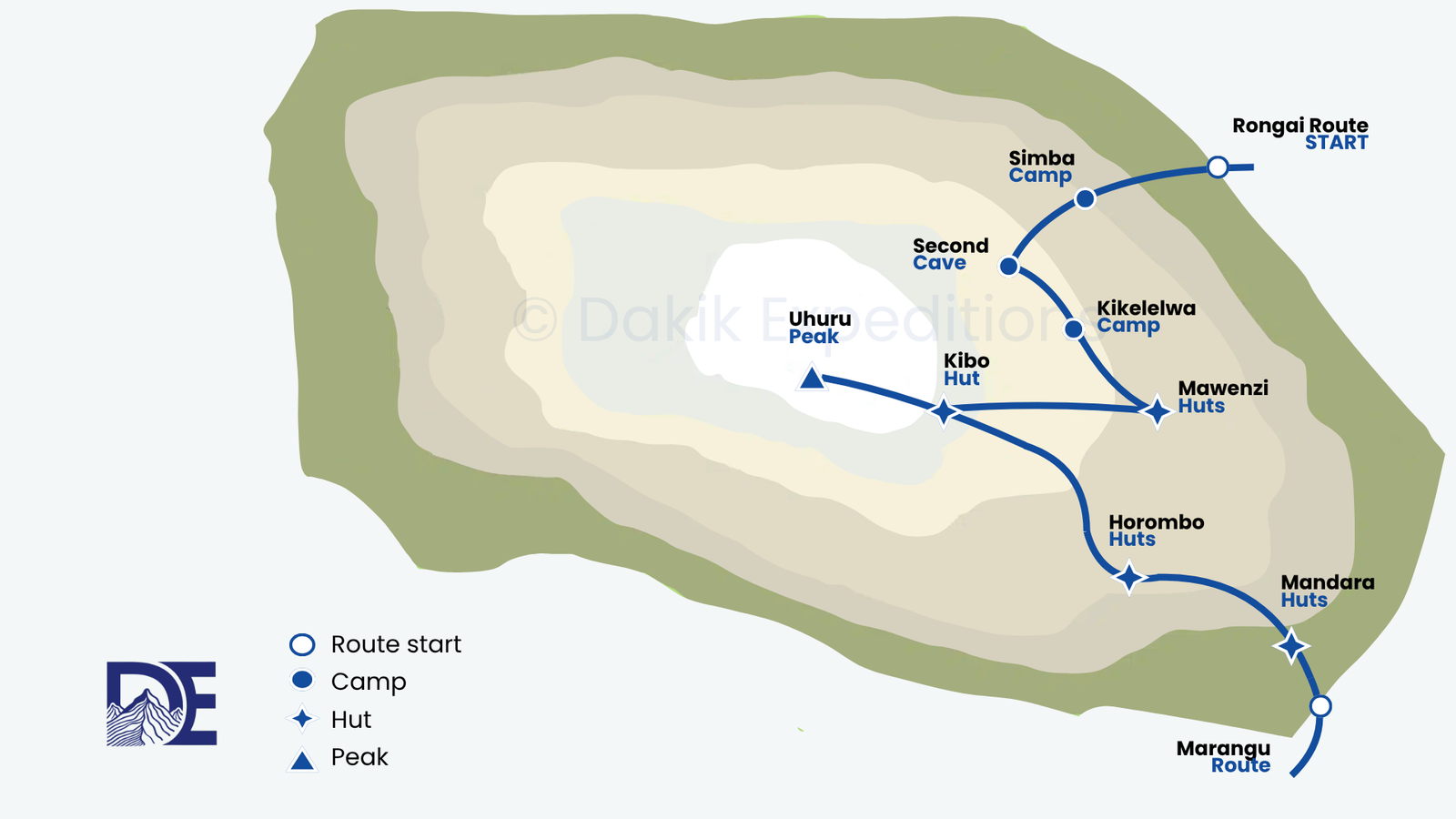
Rongai ascends the northern face and descends via Marangu on the south. One climb, two entirely different landscapes: northern moorland up, southern forest on the way down.

What makes Rongai the quietest route of Kilimanjaro?

Rongai is the only route that approaches Kilimanjaro from the north, starting near the Kenyan border. That makes it the quietest route on the mountain, you will see far fewer climbers, the northern side of the mountain receives less rainfall, and the landscape has a drier, more open character than the southern routes.

It is a steady, well-paced route with a gradual ascent that suits first-time climbers well. The path is less dramatic than Machame or Lemosho but consistently beautiful, and the views from the northern slopes are different from anything you see on the more popular routes.

Descent is via the Marangu route on the southern side, which means you cross the mountain and see two distinct landscapes in one trip.
Rongai route is best for you if you:
  • You want a quieter, less crowded experience on the mountain.
  • You prefer drier conditions and a more open landscape.
  • You are a first-time climber wanting a steady, manageable ascent.
  • You are climbing during the shoulder season when southern routes are wetter.
  • You want to approach from a different direction and see the northern face.

Pricing & What’s Included?

Essential

$ 2,750 per person
  • 3-4 star accommodation in Arusha
  • All meals on the mountain
  • Portable toilet at the camps
  • Professional Tanzanian mountain guides
  • Private porter service
  • Mess tent for eating and resting
  • Four season mountain sleeping tents
  • 2 climbers for every 1 guide
  • Daily water for washing
  • Traditional Swahili and international dining experience
  • Extra comfort features in Elite

Elite

$ 3,500 per person
  • 5 star accommodation in Arusha
  • All meals on the mountain
  • Portable toilet at the camps
  • Professional Tanzanian mountain guides
  • Private porter service
  • Lebanese culinary dining experience
  • Spacious standing expedition tent
  • Mess tent for eating and resting
  • Portable sleeping bed with mattress
  • 1 dedicated guide per climber
  • Hot shower every day on the mountain
  • Portable solar charging station

Your Rongai Route Itinerary

Each day on the mountain, clearly laid out.

You start at Rongai Gate near the Kenyan border and walk through pine plantation and then into montane forest. The trail is quiet and the pace is gentle. First camp at Simba Camp.

Duration: 4-5 hours  Elevation: 1,950m to 2,650m

The forest gives way to open moorland and heathland. The northern landscape feels more open and drier than the southern routes. Views of the summit begin.

Duration: 4-6 hours  Elevation: 2,650m to 3,550m

A longer day crossing the northern slopes with wide open views. The terrain is varied: volcanic rock, alpine desert plants, and distant views north into Kenya on a clear day.

Duration: 4-6 hours  Elevation: 3,550m to 3,800m

An optional acclimatisation day with a walk toward School Hut and back. Spending an extra night here gives your body more time at altitude before the final push. This day is always our recommendation on the 7-day option.

Duration: 3-4 hours  Elevation: 3,800m (day walk to ~4,200m)

A steady climb across the saddle to Kibo Hut at the base of the summit cone. The landscape becomes increasingly barren at this altitude. Rest, eat well, and prepare for an early start.

Duration: 4-5 hours  Elevation: 3,800m to 4,703m

Departure around midnight. The ascent to Gilman’s Point and then Uhuru Peak is long and cold but the northern approach gives you a slightly different perspective on the summit zone. Descend to Horombo via the Marangu route.

Duration: 12-14 hours  Elevation: 4,703m to 5,895m to 3,720m

Final descent through Horombo and the southern forest to Marangu Gate. You exit from a completely different side of the mountain to where you started.

Duration: 5-6 hours  Elevation: 3,720m to 1,830m

Rongai Route FAQ

Primarily because it starts on the Kenyan border side, which requires more travel from Arusha or Moshi than the southern gate routes.

That extra distance keeps the numbers down which is a genuine advantage if a quieter experience matters to you. We handle all logistics so the travel to the gate is seamless.

Yes, it is one of our recommendations for first-timers specifically because of its steady gradient and manageable pacing. The 7-day option with the acclimatisation day is the version we always suggest.

The quieter trail also means your guide can focus entirely on your group without navigating busy sections.

The northern slopes are drier, more open, and see far less foot traffic. The vegetation is different more sparse and exposed than the lush southern forest.

On a clear day you can see into Kenya from the higher sections. The overall feeling is more remote than the popular southern routes.

Rongai is one of the better options if you need to climb between April and May when the southern routes are at their wettest. The northern rain shadow means conditions are more stable and the trail is less muddy.

It is not completely dry during the long rains but noticeably more manageable than Machame or Marangu at the same time of year.

There is no viable descent on the northern side: the Rongai trail does not lend itself to a return journey in the same way that Marangu does.

Descending via Marangu means you see a second distinct landscape and exit from a proper gate with full facilities. Your transport is arranged to meet you on the southern side.